Huayang South China Sea Narrative
Wu Shicun on why Beijing will not rule out Scarborough Shoal construction
This interview was conducted by the South China Morning Post with Wu Shicun, Chairman of the Huayang Center for Maritime Cooperation and Ocean Governance and Chairman of the Academic Committee of the National Institute for South China Sea Studies.
With Manila intensifying its “transparency” campaign, how does China view the current situation and what challenges does it face?
Manila’s so-called “assertive transparency” initiative operates on its own distinct logic and playbook. [The initiative includes documenting and publicising what Manila calls Chinese grey-zone tactics, such as blockades and the use of water cannons.]
Since 2023, the Philippines has deliberately intruded into the waters around Renai Jiao [the Chinese name for the disputed Second Thomas Shoal], deliberately provoking China into intercepting its vessels or deploying water cannons.
On-board media outlets then package these confrontation scenes into short, viral videos and disseminate them globally. These clips manufacture an international perception that “China is the bully in the South China Sea and the Philippines is the victim”. This is the core mechanism behind their public relations strategy.
Behind this are Philippine domestic political considerations, aimed at securing more budget and equipment support from the Philippine Congress for its coastguard.
In contrast, Beijing’s energy has been primarily concentrated on rule-making. For instance, in promoting consultations for a Code of Conduct in the South China Sea (COC), negotiations have been grinding steadily forward for over a decade since 2013.
Concurrently, working group meetings on the implementation of the Declaration on the Conduct of Parties in the South China Sea [DOC] recently convened for their 56th session in Vietnam. These institutional frameworks are where China invests the bulk of its diplomatic capital.
Regarding narrative construction, there was a period when China was in a passive position, especially during the 2023 Second Thomas Shoal stand-off and later when the Philippines intruded on Sabina Shoal and spread false information such as “China intends to occupy the feature”.
But as we gradually recognised the Philippines’ tactics and the Western media backing behind the scenes, we began to adjust our counter-strategy, sometimes proactively clarifying to the international community Manila’s false narratives and exposing their deliberate methods of smearing China.
This is exactly why Beijing is now proposing to proactively construct a new South China Sea narrative. This shift is a direct lesson learned from countering the Philippines’ playbook.
Our strategy has undergone a profound paradigm shift; it is expected to become even more proactive in the future. Because as a responsible major power, China must always tell the truth.
Meanwhile, extra-regional countries such as the United States and Japan use the Philippines’ narrative as an excuse to intervene in South China Sea affairs, thereby binding their military apparatus to the Philippines.
The United States wants to use its military bases and supply them with weapons. Japan, through signing the reciprocal access agreement with the Philippines, has lowered the threshold for Japan’s Ground, Maritime, and Air Self-Defence Forces to enter Philippine bases; Australia, New Zealand, Canada, and other countries have also signed visiting forces agreements similar to the reciprocal access agreement with the Philippines.
Recently, Japan also participated in the US-Philippine Balikatan military exercises. In this year’s exercise involving seven countries, Japan sent more than 1,400 personnel, three warships and helicopters for the first time, and conducted live-fire drills with a surface-to-ship missile system during the exercise. This was also the first time Japan used a show of force overseas after World War II.
Even many middle powers are seeking to cash in on the friction and seek geopolitical benefits, relying on the Philippines to stir up trouble. The combination of various factors has enabled the assertive transparency initiative to achieve its expected PR goals for a period of time.
However, today the international community – other Southeast Asian countries – has gradually seen through these tactics, and the initiative’s influence is gradually weakening. The global public is no longer so easily buying into its fact-distorting hype.
With deepening defence ties between Japan and the Philippines, and strengthened Vietnam-Philippine maritime cooperation, what challenges does Beijing’s bilateral strategy of engaging in direct talks with claimant countries face and how should China respond?
This is indeed a new development. Other rival claimants are attempting to join forces to counter China on certain issues. At the same time, they have been lukewarm towards China’s initiatives that are designed to foster regional peace, stability and environmental protection while delivering tangible benefits to littoral states.
Some coastal nations are quietly conducting exclusive economic zone delimitations, which effectively encroach upon China’s rights and claims in the South China Sea, with some even crossing over into waters under Chinese jurisdiction.
Our policy remains consistent: resolving disputes through peaceful means, bilateral consultations and negotiations. Yet, we’re seeing increasingly frequent contact between Vietnam and the Philippines recently.
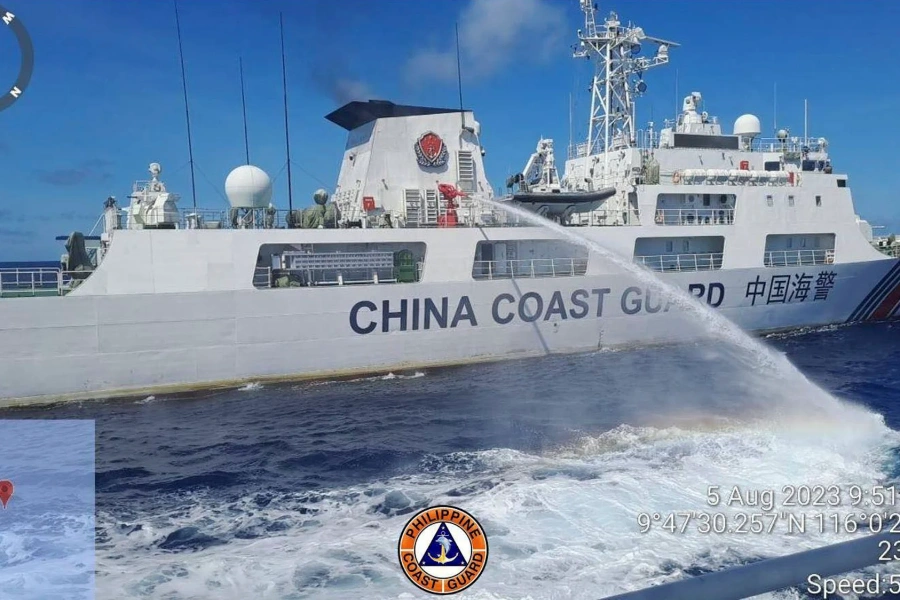
Chinese coastguards have used water cannons against Philippine ships. Photo: Philippine Coast Guard via AP
Beyond state visits, they have privately hammered out internal agreements to tighten maritime cooperation, explore the possibility of bilateral maritime delimitation, conduct joint law enforcement and share intelligence. Manila has even gone so far as to encourage Vietnamese fishermen to operate in the waters surrounding Huangyan Island [Scarborough Shoal], an attempt to pile pressure onto China’s maritime law enforcement.
Data shows that a considerable number of Vietnamese fishing vessels have appeared in waters around Huangyan Island. Video footage captured during our annual Sansha and South China Sea patrols reveals a substantial presence of boats flying the Vietnamese flag.
Considering the straight-line distance from Vietnam to these waters is nearly 1,000km (600 miles), such long-range cross-sea fishing operations are economically unsustainable for ordinary fishermen.
Without government subsidies and escort protection provided by the Vietnamese and Philippine coastguard authorities, these fishermen are likely to return empty-handed. Therefore, there is undeniably state backing and financial aid behind this.
There is clear growing coordination between rival claimants and with extra-regional countries, and Beijing is fully aware of it. However, I do not believe this poses a substantial threat to China’s rights and claims.
If they ever choose to make these delimitation agreements public – agreements that bypass China and violate our sovereign rights – Beijing simply will not recognise them, and it has a comprehensive suite of countermeasures at its disposal.
These countries are well aware of this reality, which explains why they prefer to quietly put delimitation on hold. Take the delimitation between Vietnam and Indonesia as an example. Although both sides signed a delimitation agreement, the boundary maps and geographical coordinates that should customarily be submitted to the UN Secretary General have yet to be provided.
Could you elaborate on what specific measures Beijing might take?
No matter how other countries attempt to draw these maritime lines, if an action infringes upon China’s interests, we will not only refuse to recognise it but will simply carry on with business as usual.
Take the attempts by Japan and the Philippines to delimit boundaries in the waters east of Taiwan – even if they draw their lines, China will absolutely never recognise them. Such behaviour will ultimately prove counterproductive for them, instead prompting China to further strengthen maritime law enforcement operations and enhance its actual presence in relevant waters.
I don’t believe these countries have thought this through properly. The era when China had its hands tied is gone. If they are trying to play petty games, they have completely miscalculated.
Why does Beijing treat Vietnam and the Philippines differently in the South China Sea dispute and how should it balance maritime tensions with Hanoi against the commitment to building a community with a shared future?
A US scholar previously asked me whether China was applying a “double standard” to Hanoi and Manila.
I told him plainly that when it comes to infringements in the South China Sea, China has no double standards. China has red lines whenever its rights and claims are violated – it’s simply the handling methods that differ.
The Philippines relies heavily on hyping things up through “megaphone diplomacy”, playing the victim card to court international sympathy. Manila deliberately provokes China’s rights and claims, anticipating that China will step in to carry out law enforcement and use water cannons. In its pursuit of so-called transparency, Manila behaves rather like a child who screams the moment you barely touch them.
As for Vietnam’s island-building, China’s opposition has been consistent and clear. We have repeatedly lodged diplomatic representations through both state-to-state and party-to-party channels, demanding that Hanoi halt such constructions.
These activities violate the Declaration on the Conduct of Parties in the South China Sea, disrupting regional peace and stability while complicating the situation and escalating tensions. Its actions also do nothing to help the ongoing negotiations for the Code of Conduct in the South China Sea.
Data published by the Asia Maritime Transparency Initiative (AMTI) confirms Vietnam’s actions. For example, Vietnam has been carrying out reclamation work across 18 islands and reefs [in the Paracel Islands].
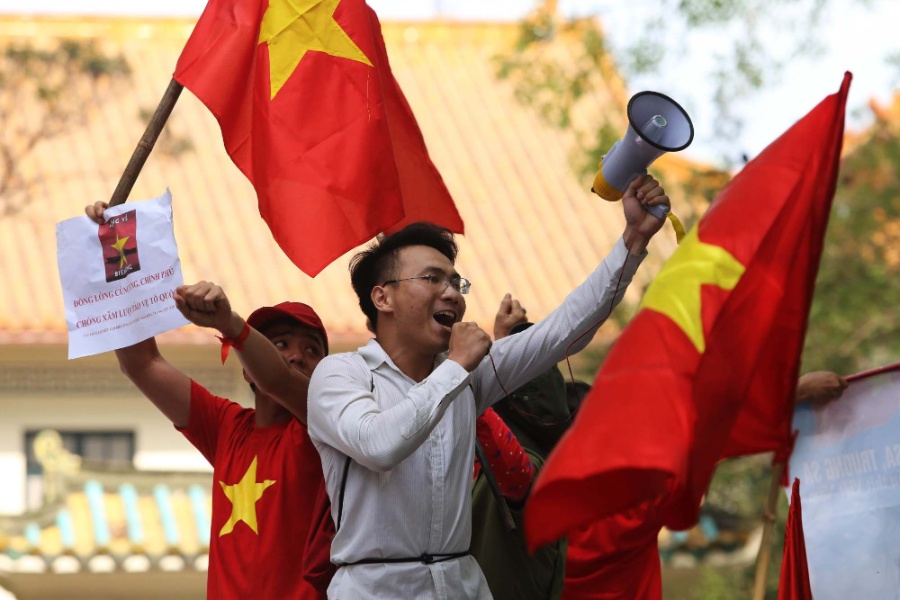
Anti-China protesters wave Vietnamese flags and shout slogans in front of the Chinese embassy during a rally in Hanoi in 2014. Photo: AFP
Hanoi’s dredging across the archipelago has pushed its total artificial land mass past 11 sq km (4 square miles), putting its reclamation scale on a trajectory to rival or even exceed what China built between 2013 and 2015.
It is the tactics deployed by Beijing that differ, purely because Hanoi and Manila employ entirely different methods. Vietnam operates quietly.
Moreover, China does not wish for these island-building activities to derail the broader Sino-Vietnamese relationship, as the disputes do not represent the entirety of our bilateral ties. We are keen to avoid a situation where poor management or mishandling of maritime friction damages our bilateral relations or harms China’s ties with the Association of Southeast Asian Nations.
Crucially, there is a deep-seated consensus between our two ruling parties, encapsulated in the “16-character guideline” [friendly neighbourliness, comprehensive cooperation, durable stability and looking towards the future] and the “Four Goods” spirit [being good neighbours, good comrades, good partners and good friends]. This is the big picture of Sino-Vietnamese relations.
How effective has China’s island-building been in protecting its maritime interests over the past decade and does Beijing still hold its “Big Triangle” strategic advantage – the highly fortified outposts at Fiery Cross, Mischief, and Subi Reefs – in the Spratly Islands, given Vietnam’s accelerated reclamation activities?
Whether China’s strategic edge remains intact largely depends on Vietnam’s subsequent moves once its island-building projects are wrapped up. Although Hanoi has pledged to deploy only civilian facilities, it remains to be seen whether they will actually walk the talk.
Vietnam occupies a considerable number of features, most notably Barque Canada Reef, which boasts the largest reclaimed footprint and is highly capable of supporting an airstrip.
According to data published by the AMTI, some experts estimate that Vietnam could eventually possess six to seven runways and 15 harbours across the Nansha [Spratly] Islands.
If these facilities are geared towards military purposes, might they be opened up for shared use with the US or Japan down the line? After all, Vietnam’s military and security cooperation with Washington and Tokyo has deepened significantly and intelligence-sharing is already under way.
Should they begin to pose a security threat to our civilian facilities, fishermen and garrisoned troops on those reefs, Beijing will certainly roll out appropriate countermeasures.
However, taking a broader view, this will not, in the short term, exert a disruptive or game-changing impact on China’s current capacity to safeguard its rights, law enforcement or project its maritime power.
You’ve said island-building could continue if necessary. Where would be the most critical location for reclamation, Scarborough Shoal or Antelope Reef? Why has China chosen this moment to dredge Antelope Reef after refraining from large-scale reclamation for the past decade?
Whether to build on Huangyan Island depends on several factors. Firstly, will intrusions into the territorial sea baseline around Huangyan Island that China announced in 2024 become the norm, as well as challenges from the Philippines and other external forces in future?
If parties enter territorial waters or fly through airspace without declaration and permission, China will certainly take countermeasures. Therefore, this potential security threat is an important precondition.
Secondly, the Philippines has consistently claimed that its fishermen enjoy “traditional fishing rights” in Huangyan Island’s lagoon – something China absolutely does not recognise.
If the other party frequently engages in such infringements and damages the marine environment in Huangyan Island’s waters, it will place enormous pressure on China’s rights protection and law enforcement.
Currently, Chinese coastguard vessels face very long voyages and substantial logistical costs for resupplying and travelling between Huangyan Island and home ports.
If future challenges make our maritime law enforcement difficult to manage, then in future we cannot rule out constructing some fixed facilities on Huangyan Island to meet the supply needs of law enforcement vessels and other transport vessels or provide humanitarian medical assistance.
Looking ahead, in the waters east of the Huangyan Island, joint patrols by non-regional actors such as the United States, Australia and even Japan – alongside the Philippine Coast Guard and Navy – are likely to become increasingly frequent.
In the absence of mutually observed rules of engagement, the probability of maritime collisions will only rise. Should an incident result in casualties, could the United States intervene? That possibility exists.
China will not proactively engage in further land reclamation or island-building. However, the possibility of constructing certain fixed facilities to meet the requirements of defending our legitimate rights remains on the table. If Beijing ultimately takes this step, it is because external forces have left us with no choice.
Is China’s dredging at Antelope Reef in the Paracel Islands a direct response to Vietnam’s island-building in the Spratly Islands? Or are there other calculations at play?
Some have tried to frame this as a tit-for-tat scenario – suggesting that because Vietnam is reclaiming land in the Spratlys, China is doing the same in the Paracels – but that is simply not the case. These are two completely unrelated matters. China has never recognised any dispute with Vietnam over the Paracel Islands.
China’s actions in the Paracel Islands are primarily because it still faces rights infringements and illegal fishing from some neighbouring countries, and even provocations by foreign military and police vessels. For instance, the recent entry of a Dutch frigate into the territorial waters of the Paracel Islands proves that our control in that area still has vulnerabilities.
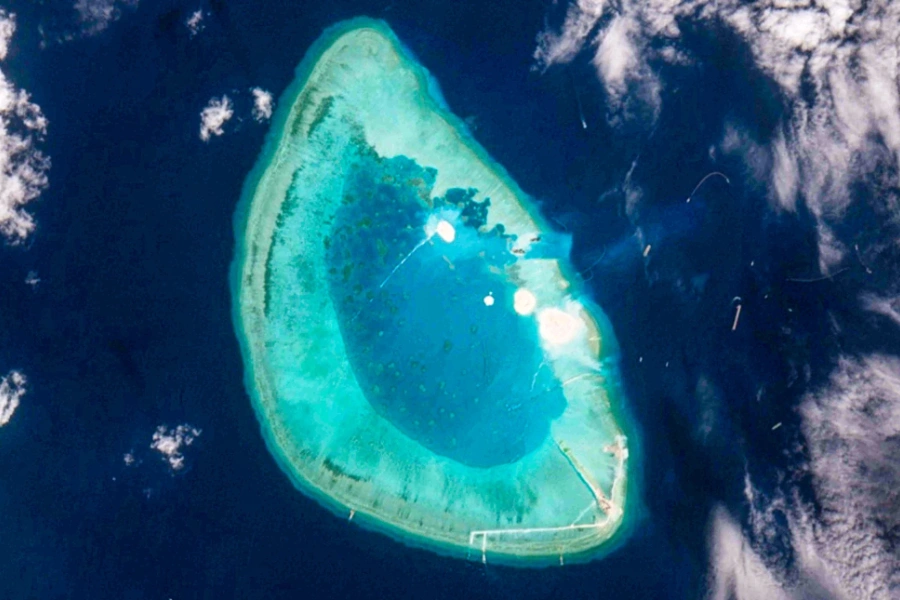
Satellite imagery from the European Space Agency’s Sentinel-2 satellites shows sand dredging activity at Antelope Reef. Photo: European Union
As for Antelope Reef, Beijing’s activities are predominantly for civilian purposes, aimed at protecting and restoring the marine environment. This does not correlate whatsoever with Vietnam’s construction work in the Spratly Islands.
I told my American counterpart plainly that if China genuinely intended to counter Vietnam’s island construction, we would take action in the Spratly Islands rather than at Antelope Reef. The Paracel Islands are undisputed territory and we are fully entitled to carry out any lawful activities when we see fit.
With tensions escalating last month over a Chinese floating platform at Scarborough Shoal and Beijing’s designation of the area as a nature reserve last year, how do you see the situation evolving and what challenges does China face there?
This hinges entirely on external factors, not on China.
Beyond the long-running friction over Second Thomas Shoal, Manila has recently made frequent attempts to step up its control over Sandy Cay. Beijing remains highly vigilant to prevent the Philippines from establishing de facto control over the feature.
The Philippine side has previously tried on multiple occasions to deliberately ground its vessels on Sandy Cay, using the same playbook as Second Thomas Shoal [where it grounded a World War II warship in 1999 and has kept troops stationed on it since then].
China explicitly demanded that they tow the vessels away; if they refuse to do so, we will tow them away ourselves. We are fully awake to these manoeuvres and any attempt by Manila to seize control of Sandy Cay is a complete non-starter.
China itself has no intention of controlling Sandy Cay, but we must prevent Manila from occupying new reef formations. Although the Philippines claims Sandy Cay is part of Zhongye Island [Thitu Island], Sandy Cay is, in fact, an uninhabited sandbank.
According to Article Five of the DOC, parties cannot undertake occupation of uninhabited islands and reefs. Therefore, precisely what China is doing is preventing Manila from undermining the consensus reached in the DOC and preventing it from occupying new islands and reefs – this is actually upholding the authority of the DOC.
In your view, aside from the well-known issues of geographical scope and making it legally binding, what are the lesser-known but critical hurdles to concluding the COC?
I remain deeply sceptical about the likelihood of this happening under the current Philippine Asean chair. Last year, when Malaysia chaired Asean, I genuinely believed they had the ideal conditions and the strongest political will within Asean to bring the COC across the finish line; yet, even they could not seal the deal.
Although the consultations have now completed their third reading, profound disagreements persist over core provisions such as the geographical scope of application, its legally binding force, and the precise relationship between the DOC and the COC.
There is the thorny issue of defining third-party interests. How exactly do you define these third-party interests? Once the code is signed and takes effect, will non-regional states still be permitted to conduct military exercises in the South China Sea? Can foreign oil majors continue oil and gas exploration in these waters? Will actions that might impinge upon another nation’s rights, claims or maritime interests be outright prohibited? These are the critical questions.
Another fundamental roadblock is the disagreement over the nature of the mechanism itself. From Beijing’s perspective, the COC is strictly a crisis-management mechanism, while conversely, countries like Vietnam and the Philippines want the COC to act as a dispute-settlement mechanism, which would mean dragging territorial and sovereignty disputes into a multilateral framework.
China has always opposed this. We maintain that disputes can only be resolved through peaceful bilateral consultations; trying to settle these disputes under the COC framework is a total non-starter.
This remains a major point of divergence between China and certain Asean members, layered on top of the numerous internal squabbles among the claimant states themselves. In this sense, the obstacles are numerous, and we have truly entered deep water. We are already halfway through the year, with only six months left.
Moreover, it is impossible for the Philippines to set aside the relevant provisions of the arbitration award. [In 2016, a tribunal in The Hague concluded Beijing’s sweeping territorial claims had no legal basis after a case brought by the Philippines. Beijing did not participate in the tribunal nor did it recognise or implement it.]
They will try every means possible to insert the provisions of the award that favour them into the COC.
If they can solidify the arbitration terms through a multilateral agreement that potentially has binding force, their objective will be achieved. But as long as it involves any content related to the arbitration, China will absolutely not agree to its inclusion in the COC.
What are the prospects for joint oil and gas development in the South China Sea after President Ferdinand Marcos Jnr expressed his willingness to negotiate with China this March, and what are the main areas of disagreement between claimants?
We have to place a question mark over the credibility of words coming from Marcos. He has made numerous promises but they often turn out to be nothing. He might flash a positive signal to serve a specific purpose at a given moment, but whether he actually follows through is an entirely different matter.
He has recycled this rhetorical playbook several times already. As early as 2022, he told the media that he wanted to diversify the Philippines’ oil and gas imports, hinting that he did not rule out restarting negotiations with China over energy cooperation in the South China Sea.
Beijing and Manila signed 29 bilateral agreements and memorandums during President Xi Jinping’s state visit to the Philippines in December 2018. Among them was the landmark Memorandum of Understanding on Cooperation on Oil and Gas Development.
However, days before stepping down in 2022, [then-president Rodrigo] Duterte formally terminated all discussions and the 2018 MOU on joint oil and gas cooperation with China. Although Marcos revived this rhetoric upon taking power, it remains strictly a verbal exercise, completely devoid of any concrete action.
Recently, the global energy market volatility sparked by the crisis in the Strait of Hormuz has hit Manila hard. Combined with the near-depletion of its domestic reserves, the Philippines relies on imports for more than 90 per cent of its oil and gas needs.
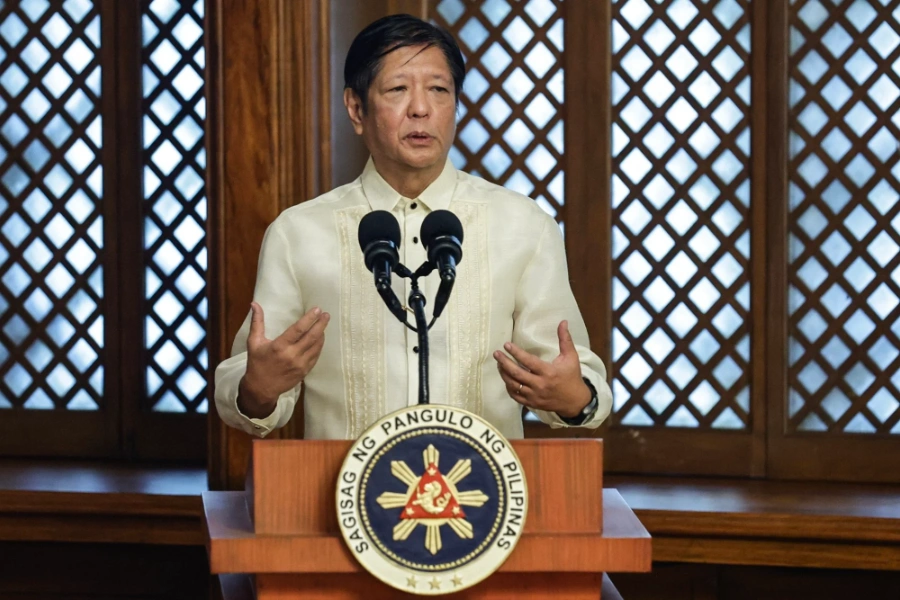
Philippine President Ferdinand Marcos Jnr has signalled a desire to restart cooperation with China. Photo: EPA-EFE
This vulnerability has triggered a sharp spike in domestic fuel prices, fuelling inflation and causing an economic slowdown. It is against this grim economic backdrop that Marcos has once again dangled the prospect of cooperation with China.
He acts this way because he knows perfectly well that China holds massive financial clout and advanced technical expertise. He is also well aware of the 2005–2008 tripartite agreement between China, the Philippines, and Vietnam – the Joint Marine Seismic Undertaking – which we view as the first potentially successful attempt at joint development in the South China Sea. However, after that pact expired in 2008, follow-up joint exploration ground to a halt.
[The Philippine constitution says the state must retain full control over natural resources. In 2023, the Philippine Supreme Court struck down the joint exploration agreement with China and Vietnam on constitutional grounds.]
While Marcos drops hints about restarting cooperation today, it is all talk and no action. Frankly, whenever he signals a desire for Sino-Philippine cooperation, I take it with a generous pinch of salt.
Given your advocacy for starting with small-scale, low-sensitivity issues before moving to multilateral initiatives for the South China Sea, where do you see the most promising areas for cooperation?
Maritime cooperation between China and other claimant states can be seamlessly pursued under the framework of the DOC. The protection of fishery resources stands out as both practically viable and urgently necessary.
Scientific monitoring data paints a grim picture: rampant IUU (illegal, unreported, and unregulated) fishing by certain nations has left the South China Sea severely depleted, plagued by overfishing and facing the outright extinction of rare species.
Coastal states could deploy researchers to conduct a unified, scientifically rigorous audit of fishery stocks across the South China Sea, including within the so-called disputed waters.
This would help establish an objective baseline: are we dealing with chronic overfishing, or is there still a sustainable surplus? If overfishing is confirmed, we can then co-design robust conservation strategies.
Currently, China unilaterally enforces a three-and-a-half-month summer fishing moratorium in waters north of 12 degrees north latitude.
Yet, countries such as Vietnam and the Philippines not only flout the ban but also actively lodge diplomatic protests against it. During a track-two dialogue with my Vietnamese counterparts, I said that if Hanoi feels politically uncomfortable endorsing a Chinese-initiated fishing moratorium, they can simply implement their own to rein in their fleets. After all, the ban coincides precisely with the peak spawning season. Safeguarding fish stocks is a matter of common interest for every state.
By conducting joint stock assessments, we could build a shared database, pool information, determine total allowable catches and figure out how to divide the pie – whether through strict quotas or a coordinated licensing system.
These are low-hanging fruits that are not only highly achievable but absolutely imperative. They represent the easiest starting point.
So why do I place such heavy emphasis on a “bilateral first” approach? Because dragging these issues straight into a multilateral framework inevitably invites a chaotic cacophony of discordant voices.
Given the profound deficit of mutual trust in the South China Sea right now, certain capitals have adopted a reflexively anti-China posture. They are reluctant to sign up for initiatives that are blindingly obvious wins for the marine environment, regional fisheries and our shared ecological neighbourhood.
Therefore, we must test the waters bilaterally first, starting with countries where mutual trust already exists – such as Malaysia, Indonesia or Vietnam.
As I pointed out during track-two talks in Hanoi, look at what we achieved after delimiting the Beibu Gulf [Gulf of Tonkin].
Our maritime law enforcement agencies have institutionalised joint operations and our navies have conducted over 30 joint patrols. Together we inspect rogue fishing vessels and coordinate fish-fry releasing programmes to replenish marine life.
If Beijing and Hanoi can pull this off in the Beibu Gulf, what is stopping us from replicating the same blueprint in waters beyond it? Crucially, engaging in this type of environmental cooperation does not prejudice or compromise anyone’s claims.
This is the essence of what I call finding a “small-scale” and adopting a “bilateral first” strategy. We cooperate with willing partners where initial trust exists and demonstrate tangible rewards. Only then can we realistically scale up to trilateral arrangements, and eventually weave in all the littoral states of the South China Sea.
Moreover, the South China Sea is currently choking on plastic pollution, with the microplastics crisis reaching alarming proportions. While Vietnam has rolled out some domestic measures, saving the waterway’s ecosystem is far too big a job for any single country acting in isolation.
It demands a collective, all-hands-on-deck response. As the largest coastal nation, China possesses the technical muscle, financial resources and political will to bankroll and anchor these initiatives.
However, the prerequisite remains unchanged: our neighbours must work with Beijing in the same direction, rather than opposing our overtures out of sheer “anti-China thinking”.
This April, a minister-level official from Taiwan visited the Taipei-controlled Taiping Island or Itu Aba. How do you evaluate Taiwan’s stance on the South China Sea dispute?
One trend has become glaringly obvious since the [former leader] Tsai Ing-wen era: the Taiwan authorities’ South China Sea policy has taken a sharp turn and distanced itself from the mainland.
The Democratic Progressive Party ran an internal assessment which concluded that if Taipei mirrored Beijing’s position on the South China Sea, the mainland would reap all the political credit while Taiwan would lose out. Since then, Taipei has pursued a policy of “de-mainlandisation”.
Simultaneously, to court favour with Asean, Taiwan has deliberately catered to the US and Japan while echoing Asean’s rhetoric. Because Asean includes South China Sea claimant states, the Taiwan authorities dare not offend them, resulting in prolonged silence on other claimants’ infringements. They’ve even criticised the mainland’s legitimate measures to protect rights, such as the establishment of the Huangyan Island nature reserve.
This creates a jarring paradox: instead of working along with the mainland to defend our shared maritime rights, Taiwan is running in the opposite direction and standing with our adversaries. It risks becoming a strategic “negative asset” for the Chinese nation’s sovereignty protection.
While the separate governance across the Strait is a present-day reality, the indisputable fact remains that the South China Sea islands and their adjacent waters are the ancestral property of the entire Chinese nation. This is a reality that cannot be sidestepped. So Taiwan should avoid standing in opposition to the mainland and side with other claimant states, becoming a negative asset in our rights protection.
Furthermore, we must remain highly vigilant about potential geopolitical security risks that Taiping Island’s developments might create in the future, as it was proposed by Tsai that the island should become an “international humanitarian rescue hub”.
The Taiwan authorities have continuously extended the airport runway and expanded the harbour on the island in recent years.
Given that US Navy survey vessels have previously docked at Kaohsiung Port, we cannot rule out that US and Japanese military aircraft and vessels might exploit Taiping Island’s positioning to dock at Taiping Island in future, using humanitarian aid or emergency personnel assistance and material supplies as pretexts to gradually test the mainland’s bottom line.
Should the Taiwan authorities open Taiping Island to extra-regional countries such as the US and Japan, evolving into actions targeting the mainland and infringing upon our sovereign rights, this would be crossing the mainland’s red line. We will certainly take forceful countermeasures.
You previously noted China lags behind Western countries in high-level international law expertise on South China Sea issues. What improvements can China make in this regard?
We actually don’t lack international law talent. China currently possesses a large cohort of outstanding professionals who have either received rigorous international law education in the West or undergone systematic international law training domestically.
However, these talents are still relatively infrequent in voicing their views on the international stage. Therefore, we still have considerable room for optimisation and improvement at the policy level, with the key being how to enable more of these excellent professionals to enter the international public discourse arena, articulate China’s position, tell China’s South China Sea story well, and other stories too.
Secondly, we must build our own discourse platforms and these platforms must completely adopt international conventions in their conference formats. While we currently have some conference platforms, because they haven’t fully aligned with international standards to a certain extent, their appeal and influence on the international community remain insufficient.
At conferences hosted by the Philippines and Vietnam, I can completely articulate Chinese views and even directly criticise the Philippines or Vietnam. Our own platforms should also possess such an open and inclusive attitude. Everyone can engage in equal exchanges and even openly debate.
International recognition of a scholar requires a lengthy process. Therefore, we must be patient, providing support through policies and platforms, encouraging them to gain more international experience.
Read the original interview at: https://www.scmp.com/news/china/diplomacy/article/3360243/wu-shicun-why-beijing-will-not-rule-out-scarborough-shoal-construction