A New Critique of the South China Sea Arbitration Award
The National Institute for South China Sea Studies (NISCSS) and the Huayang Center for Maritime Cooperation and Ocean Governance established a research task force led by Dr. Wu Shicun, Chairman of the Huayang Center and Chairman of the Academic Committee of NISCSS, serves as Chief Expert. The team brought together leading scholars of international law from China and abroad. With legal support and advisory services provided by the London-based law firm Fietta LLP, the team prepared the report A New Critique of the South China Sea Arbitration Award and released it both in China and internationally. The report aims to subject the “South China Sea Arbitration Award” to renewed and rigorous academic scrutiny, identify the flaws in its legal reasoning, and assess its broader legal and practical consequences.
Critique of the South China Sea Arbitration Award
Critique of the South China Sea Arbitration Award
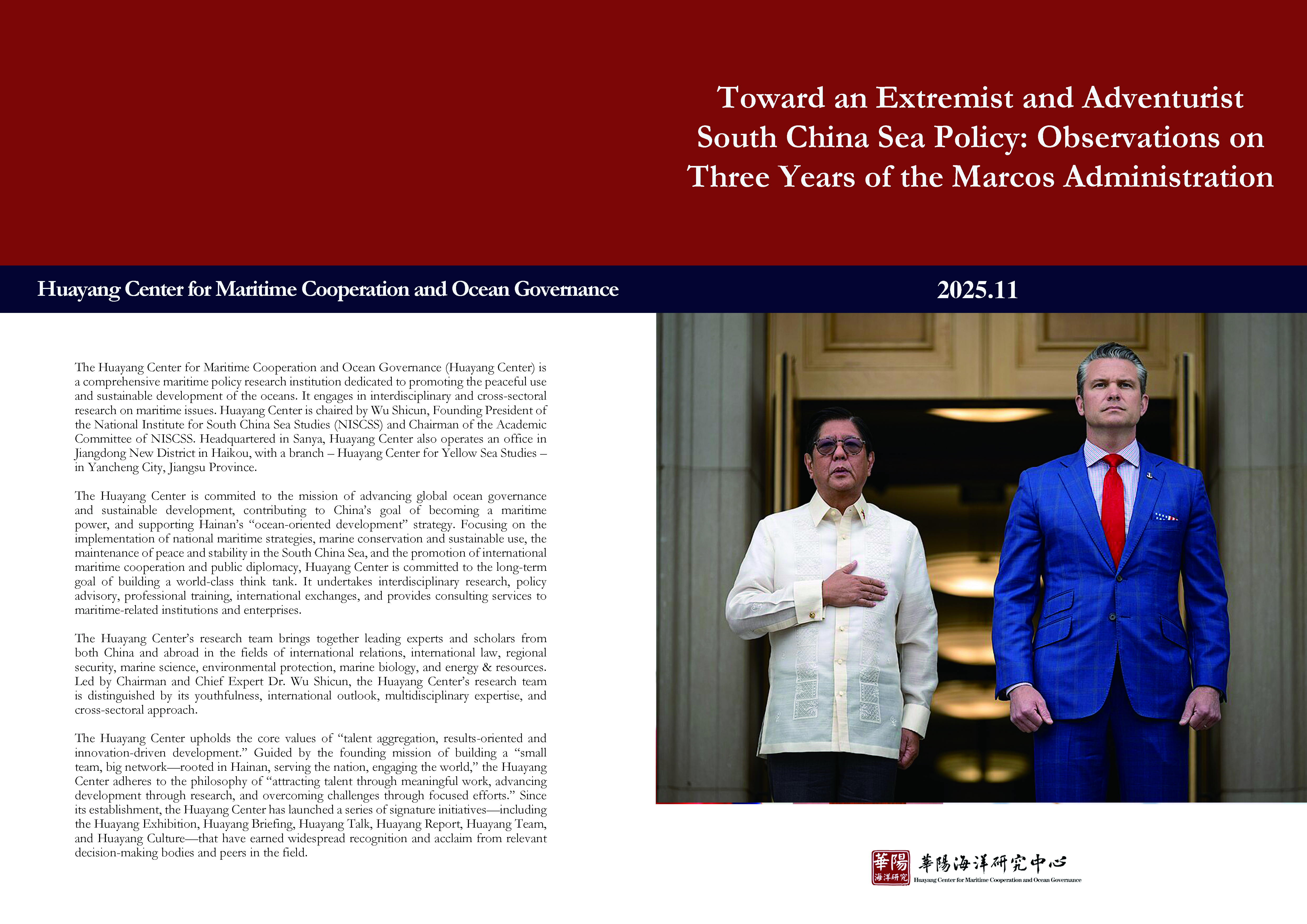
Toward an Extremist and Adventurist South China Sea Policy --Observations on Three Years of the Marcos Administration
The Philippines is a key party to the South China Sea disputes, claiming jurisdiction over waters within 200 nautical miles of its coast, while also asserting sovereignty over Scarborough Shoal in the Zhongsha Islands and certain features in the Spratly Islands. Since the 1960s, the Philippines’ policy actions concerning the South China Sea disputes can be summarized as “one main thread and three measures”: focusing on the goal of maritime expansion; illegally occupying certain islands and reefs through military and gray-zone tactics; strengthening its claims through domestic legislation and by resorting to third-party mechanisms; and seeking U.S. support to consolidate and expand its maritime claims.