Huayang South China Sea Narrative
US and China must team up to keep maritime trade routes free and safe
With the end of the 60-day US-Iran memorandum of understanding, tensions in the Strait of Hormuz have flared again. The crisis in the strait highlights how the security and stability of key international waterways are becoming an increasingly urgent global concern.
Over the past decade, major maritime routes have been affected by regional armed conflicts, geopolitical tensions and growing security risks. These disruptions have exposed a vulnerability in the global trading system: a key international waterway need not be formally “blocked” for shipping to become constrained.
A strategic international strait may remain legally “open” while ships face military threats, attacks, higher insurance premiums, sanctions-related risks, forced re-routing or arbitrary conditions for passage. In such circumstances, the question is no longer simply whether the waterway is “open” or “closed”, but whether ships can pass through it safely, predictably and at a reasonable cost. This distinction matters significantly to both China and the United States.
Global trade and energy transport depend on a limited number of key waterways, particularly the English Channel, Strait of Malacca, Strait of Hormuz, Panama Canal and Suez Canal. Disruption in any of these chokepoints can quickly spread through global markets by raising freight and insurance costs, delaying supply chains and driving up energy prices.
China is particularly dependent on maritime transport for its trade and energy supplies. The Strait of Malacca is a major gateway for China’s trade with the Middle East, Africa and Europe, while the Strait of Hormuz is critical to energy flows. That is why China keeps emphasising that, for the Strait of Hormuz, “ensuring unimpeded passage serves the common interest of the international community”.
The US is also deeply embedded in the global maritime system. Although its energy structure and trade patterns differ from China’s, disruptions to key international waterways impose economic costs too, while increasing the resources Washington must devote to protecting global maritime security.
Strait of Hormuz: shipping activity in the world's busiest oil chokepoint
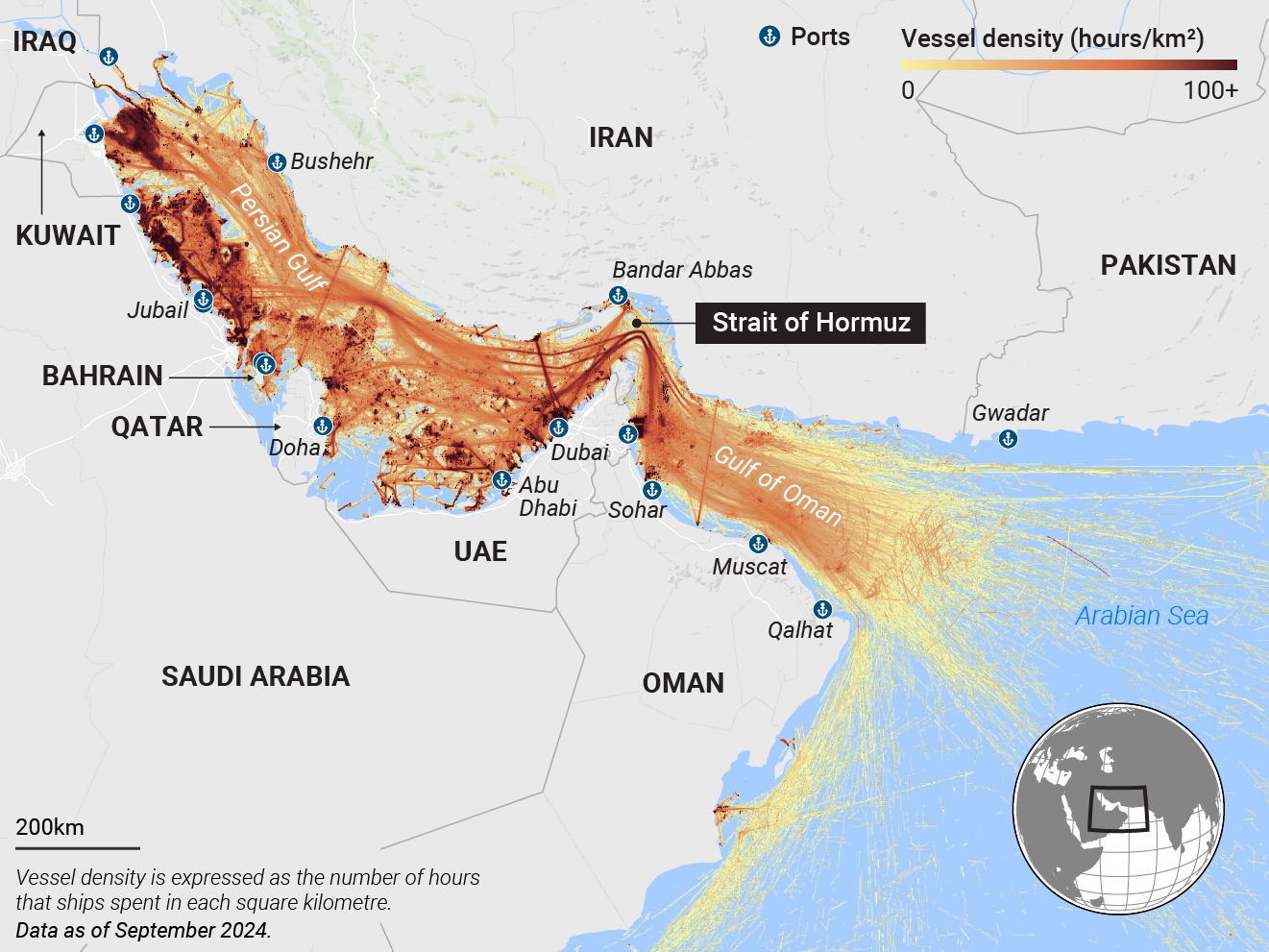
Source: Global Maritime Traffic and Natural Earth
For both China and the US, the continued availability of key international waterways is not merely a regional security issue. It is a basic condition for a functioning global economy.
The crisis in the Strait of Hormuz suggests that the traditional distinction between an “open” and a “closed” waterway may no longer be sufficient.
A key international waterway can remain formally “open” while becoming increasingly difficult or expensive to use. Military threats can deter commercial vessels. Armed attacks can force ships to seek alternative routes. Sanctions and compliance risks can make certain voyages commercially unattractive. Higher insurance premiums can have a similar effect.
More worrying is the possibility that political or military non-state actors like the Houthis may attempt to impose explicit conditions on passage, such as fees, permits or selective, even discriminatory restrictions. If such practices become normalised, the principle of free and non-discriminatory passage could gradually be hollowed out without any formal declaration of a “closure” or “blockade”.
The Strait of Hormuz illustrates the danger. Recent concerns over possible restrictions and charges for passage have highlighted how quickly a key international waterway can become entangled in a broader political confrontation. The recent Red Sea attacks show another dimension of the problem: non-state armed groups can disrupt international shipping even without exercising formal control over the waterway.
These developments should concern both China and the US. Neither state benefits from a world in which key international waterways can become instruments of political pressure or economic coercion, even from a non-state actor like the Houthis.
Undoubtedly, China and the US have profound differences over security, geopolitics and the international order. Nevertheless, cooperation to ensure free passage in key international waterways does not require the two states to resolve these broader disputes.
There are areas in which their interests overlap: maritime safety, search and rescue, protection of commercial shipping, maritime information sharing, anti-piracy efforts and prevention of marine pollution. These are practical issues with relatively low political sensitivity.
In this regard, China’s experience in the Gulf of Aden is particularly relevant. This month, the navy dispatched its 49th escort task force to the Gulf of Aden and waters off Somalia. Since December 2008, Chinese naval forces have taken part in international anti-piracy operations and escorted thousands of commercial vessels. As a result, over the years, China has accumulated substantial experience in long-distance escort operations and maritime security cooperation.
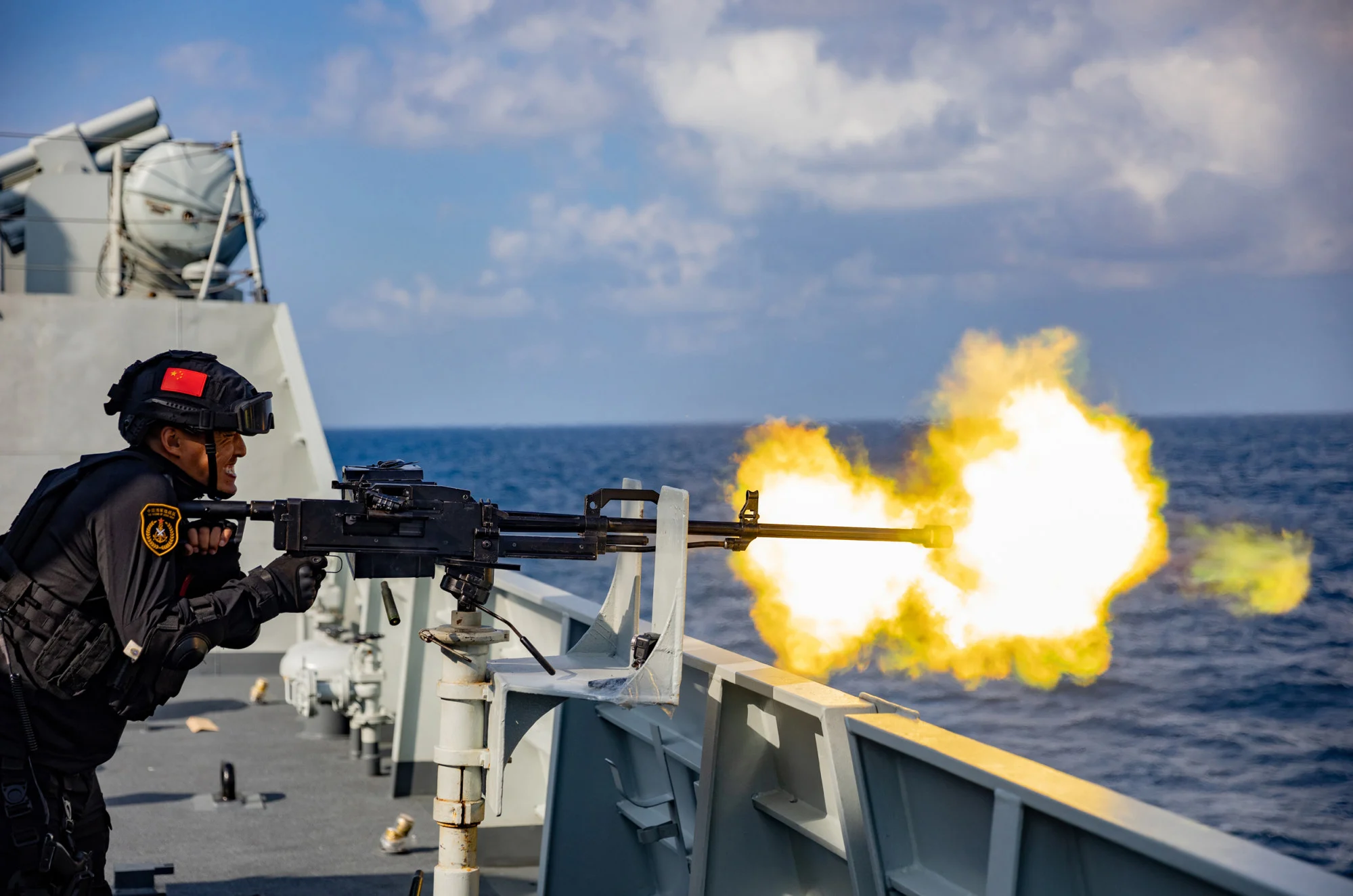
A soldier shoots during combat training of the 42nd fleet of the Chinese People’s Liberation Army Navy, on January 31, 2023. The Chinese naval fleet returned to east China’s port city of Qingdao in Shandong province after completing its mission of escorting civilian vessels in the Gulf of Aden and in the waters off Somalia. Photo: Xinhua
For China and the US, strategic competition should not prevent cooperation where their fundamental interests coincide. Indeed, maintaining the free passage through key international waterways could become a concrete area where the two states can pursue practical cooperation while continuing to disagree on broader global issues.
The objective need not be a new bilateral maritime security alliance. Nor should either state seek special “control” over any strategic international waterway. The more modest and realistic goal is to prevent critical maritime chokepoints like the Strait of Hormuz and Bab-el-Mandeb from becoming permanently unsafe, prohibitively expensive to use or subject to arbitrary conditions set by coastal states like Iran and Oman, or armed groups like the Houthis.
In an increasingly fragmented international environment, keeping key international waterways open is a shared interest for both China and the US. These two major powers may not agree on many issues concerning the future of the international order, but both have a high stake in ensuring the world’s maritime arteries remain safe, predictable and accessible to commercial shipping.
With the leaders of both countries set to meet in Washington next month, this specific common interest deserves greater attention.
This article was originally published on SCMP. Author: Bao Yinan, Associate Research Fellow at Huayang Center for Maritime Cooperation and Ocean Governance.